Tuesday, 7 July 2015

Toronto 2105 Pan Am Games – Post 1: The Excitement Builds


I’m taking a week or two off from the Tip of the Week in order to blog about an exciting event in Toronto – the 2015 Pan Am Games.

Twice in last 25 years Toronto has bid to host the Summer Olympic Games. Toronto lost out to Atlanta to host 1996 and to Beijing to host 2008. I got involved with the 2008 bid and can tell you it would have been a spectacular Olympics if we’d been successful with all the events clustered along Toronto’s downtown waterfront. As former athletes involved with the bid we were excited that Canadian athletes might have the opportunity to compete at home, enjoying the support of everyone in Canada’s largest city. We were also aware that hosting the games would leave a legacy of world-class sports facilities that would provide training and competition venues for future generations. Alas, it wasn’t to be, but then along came the Pan Am Games.

Nobody is under the illusion that the Pan Ams are the Olympics. The Olympic Games involve the entire world while at the Pan Ams only the 40 or so countries from the Western Hemisphere are invited to the party. Powerhouse European nations and sports superpowers like China will be missing, but for Canadian athletes having the opportunity to compete at home in a major games is still a big deal. And just as hosting the Olympics would have left a legacy, the Pan Ams will leave a legacy or world-class sports facilities across southern Ontario. It will make a difference to future generations of Canadian athletes.

There’s been the typical pre-Games predictions of disaster from the cynics (you should have heard the doom and gloom forecast for the Olympics in London and they turned out to be fantastic) and there has been a good deal of grumbling from those inconvenienced by the increased traffic caused largely by the dedicated lanes for Pan Ams traffic that have sprung up on local highways. What those people might forget is that you can’t be a world-class city without hosting mega events like this from time to time. You’ve also got to remember that all of the infrastructure improvements that the city has recently seen have been completed as a direct result of the Pan Am Games. You can’t have it both ways. I’ve always believed the lasting benefits for everyone far outweigh a few weeks of inconvenience. My advice to those complainers would be to watch “How the Grinch Stole Christmas” in hopes that their hearts might also grow a couple of sizes, then sit back and enjoy the party. Go to some events, take your kids, cheer on Canadian athletes and take your turn to play the gracious hosts that people around the world always are to traveling Canadians.

From a coach’s perspective, one of the great things about these games is that they are drawing some media attention and thrusting the spotlight on our athletes a year ahead of the traditional Olympic year burst of interest. It’s like a dress rehearsal for the craziness of the Olympic year, and for younger athletes and those older athletes that haven’t really had the spotlight directed at them before it is a valuable opportunity to gain experience that will help them next year.
It’s not like the canoe-kayak events are going to be easy either. There are some very good crews coming out of countries in the Americas,and crews that win next week are going to be, for the most part, legitimate contenders to medal at the World Championships in Milan in August. With the Worlds this year being a qualifier for next year’s Olympics in Rio, you can see the importance of these Pan Am Games as a lead into the Worlds and ultimately Rio.

Over the last week or so the excitement has finally caught up with the group that I’m involved with.  On Canada Day,  Mark Oldershaw was named Canada’s flag bearer for the Pan Ams opening ceremonies on July 9. This is a huge honor. Canadian flag bearers are generally recognized for not only their athletic success, but also for epitomizing the ideals of what it means to be Canadian – hard work, integrity, honesty and fair play. They’ve generally contributed to their community and made it a better place for everyone while they’ve been training to be the best in the world. They’re role models for our youth and ambassadors for our country and their communities as they travel around the world. Mark Oldershaw is all of those things. I could write an entire post about the ups and downs of his career, his perseverance in the face of adversity, his tremendous performance in the 2012 Olympics in London and his success in this year’s World Cup races but I’d rather wait till next year and include in that story a great performance in the 2016 Games in Rio.

It’s enough to say that members and friends of the Burloak Canoe Club were pretty excited when Mark was selected to carry the flag, and the turnout at a Pan Ams send off party last Sunday for Mark and fellow Burloak members Adam Vankoeverden (a four-time Olympic medallist and twice Olympic flag bearer), Brady Reardon and coach Scott Oldershaw (Mark’s dad) was fantastic. That excitement has continued this week with camera crews down at the club doing interviews and lots of attention from the Toronto media.

The canoe-kayak events will be held down the road in Welland, Ontario and the group training at Burloak, which also includes Phil Duscheneau of Sherbrooke, Que., Pierre-Luc Poulin of Lac-Beauport, Que. and Andrew Jessop of Halifax N.S. who will be joining Brady in K4, will be moving into the village at Brock University on Thursday. They’ll train there on Friday morning, and then head to the Opening Ceremonies Friday afternoon. Racing begins on Saturday morning and runs through till Tuesday.

I’ll try and post something every day during the canoe-kayak competition and then continue with a few posts over the rest of the games. It’s going to be fun!
 
L-R Brady, Mark, Adam
 
Mark
 
Adam

Brady
 

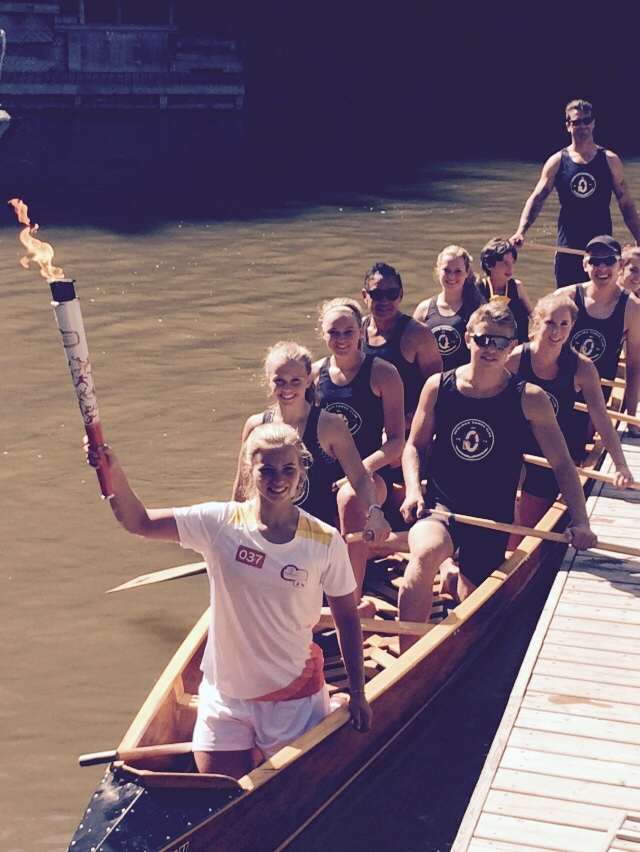
Pan Ams send off party and Torch Relay

Mark and Adam lead a parade of kids
around club at send off Party


A great turnout at the send off party
 

Mark practices carrying the flag


The Pan Ams torch relay passes
through the Burloak Canoe Club

Friday, 3 July 2015

Monitor Your Training by Keeping Some Type of Training Log


If you’re going to learn from your training then one of the most important things you can do is record all your training in some kind of log or journal.  If you work with a coach it’s a good idea because it will help you and your coach monitor your training and fatigue levels and assess the impact the training program is having on you.  If you don’t have a coach and set your own program, I’d suggest it is even more important to log your training as it will help you recognize things that are successful in helping you improve and things which are not, and it should be able to help you ensure you are cycling your training properly in order to achieve maximum results.

I have recorded all of my training in some form or other since January 1979.  It’s allowed me to look back from season to season and that has allowed me to refine my training plan.  I have always taken the philosophy that if you are trying to be the best in the world at something you should leave no stone unturned.  Spending a few minutes to reflect on your day’s training and then no more than a minute to record some details based on that reflection seems a small investment in time and energy if it can help you better understand what you’re doing in training and the effect it is having.

There are many different ways to approach this, and the key is finding the one that works best for you both in terms of convenience and meaningful detail.  Some of the new GPS/Heart rate monitors include online software that will record your training for you.  Both Garmin Connect and Polar Flow do this, and Polar’s even allows you to record your own notes for each workout.  However if you are doing strength training in the gym like you should be you’ll find it difficult to use these programs to log that, so you’ll have to have some type of ancillary log as well.  Basically it all comes down to the level of detail you wish to record.  Some people are really meticulous, recording every set of every weight workout in addition to detailed information about all their paddles and other cardiovascular work.  I tended to be much more brief in my notes, recording the workout and objective and a couple of brief notes based on workout details and how the workout went.  The point is to find a system that works for you.

A useful approach to take is to consider the training load each day. For cardiovascular workouts like paddling, running, swimming, cycling and cross-country skiing the training load can be estimated by considering the intensity and the duration of the day’s training session(s), with the intensity measure derived from either heart rate or perceived exertion. For strength training the idea is the same,only in this case intensity is measured as the percentage of your one rep max (1RM) and volume can be measured in “tonnage” (total weight lifted). You can then use these variables to sort of figure out a perceived exertion value for the entire training session.

The value of considering the training load in this fashion is that it allows you to estimate the day’s “Training Impulse” which is equal to the perceived exertion multiplied by the minutes of training. This allows you, if you’re interested, to graph your training each day. You can do it pretty easily on your computer if you’re handy with Excel or you can just do it the old fashioned way with graph paper by just plotting the training impulse on the Y-axis vs. the date on the X-axis.

At this point, if you’re not familiar with the idea of a periodized training plan, I’d suggest you go back and read my blog post from November 16, 2012 “Training for SUP Part4 – Structure of a Periodized Year Plan”. In a periodized year plan the idea is to cycle your training into chunks of increasing training loads followed by periods of lighter loading which you use to consolidate gains and prepare for the next training cycle. Generally this results in cycles of step-like build up of training load lasting two to three weeks, punctuated by periods of easier training usually lasting for up to a week.  Getting back to your training log, if you’re taking the time to graph your training impulse each day, over a three to four week period you’ll get to see how well you’re actually cycling your training as the step-like nature which I mentioned above should become readily apparent (see the blue lines on fig. 1).

While it’s great to record the quantitative information like training impulse, what about the qualitative, subjective impressions you have of how the training is affecting you? Hooper and MacKinnon (1995) suggest using seven questions to monitor factors like stress, fatigue, quality of sleep,muscle quality/soreness, attitude towards training, irritability and impression of rest and overall health. Each of these factors have been proven useful in identifying over-reaching and over-training in athletes and, although they can be affected by anything going on in our lives, often fluctuate as a result of the effects of the training program.

Hooper and MacKinnon suggest using a 7-point rating scale for each of the following questions, where a score of 1 is good and a 7 is bad (tired, over-stressed, irritable, poor quality sleep, etc.):
  1. How do I feel? (1- great…………………7-fatigued)
  2. How stressed do I feel? (1-none…………………7-stressed)
  3. Am I sleeping well? (1-yes…………………..7-no)
  4. Are my muscles sore? (1-no……………………7-very sore)
  5. Am I enjoying training? (1-love it……………………7-no)
  6. Am I irritable? (1-no………………………7-yes)
  7. Do I feel healthy and well rested? (1-yes……………………….7-no)
The sum of the scores for each of the 7 questions can then be generated and plotted on the same graph as the training impulse (see the green lines on fig. 1).


Figure 1.


Figure 1 is a graph generated by one of the sports scientists working with the Canadian Canoe-Kayak Team. It shows pretty clearly the relationship between the quantitative recording of your training (training impulse) in blue and the qualitative assessment of your training (sum of Hooper/MacKinnon questions) in green. If your training is cycled properly and you are responding appropriately the two should mirror each other with the qualitative (green) lagging slightly behind the quantitative (blue) as there is a slight lag in your body’s response to the training impulse.

The value of showing this graphically is that it allows you to pretty readily see the following:
  • Whether your training is properly cycled
  • Whether you are responding appropriately to your training impulse.

If either the training impulse or the Hooper/MacKinnon sum graph looks significantly different than shown it can quickly clue you in to problems with your training program or can help you identify issues like over-reaching in training before it becomes a full blown problem of over-training.

Whether you choose a really detailed approach to monitoring your training through some type of training log or prefer a much simpler approach, this week’s Tip of the Week is that you find some way of monitoring your training that works for you. At the very least you’ll enjoy looking back on it at the end of the season and it will help you realize all the great work you’ve done on your fitness. However if you are a serious racer, the records you keep will also contain a treasure trove of information about the training you did, its effectiveness, what worked and what didn’t. It can provide you with lots of valuable feedback on how to structure your training in the future to get maximal benefit from it while avoiding any mistakes that may have had a negative impact on your performance in the past. Give it a try.